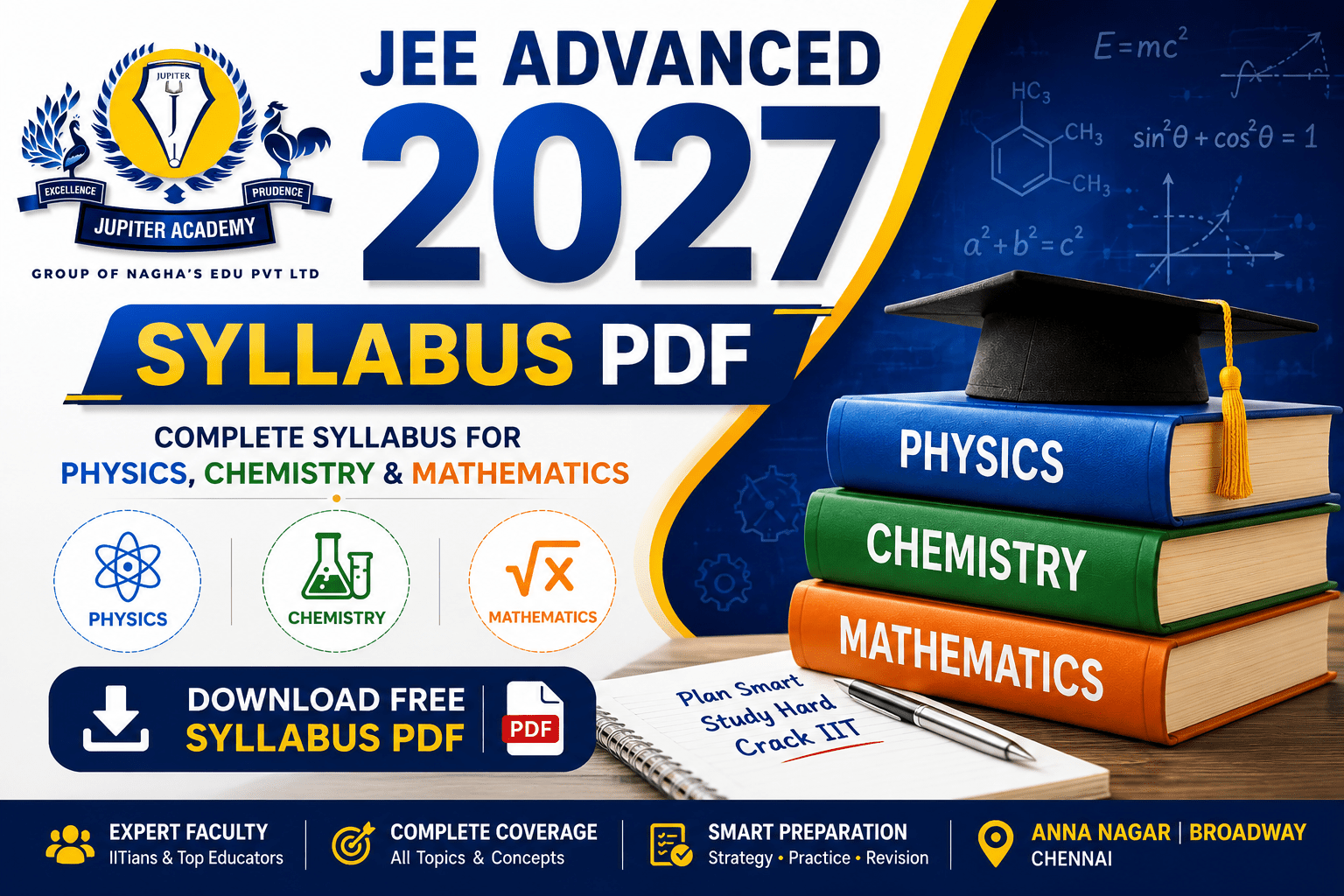
JEE Advanced 2027 Syllabus
PDF Download
Physics · Chemistry · Maths
Download the latest JEE Advanced 2027 syllabus PDF — complete subject-wise breakdown of Physics, Chemistry & Mathematics. Start your IIT journey with Jupiter Academy, Chennai.
IITs
3 Hrs each
Programs
Available
Enquire for JEE Advanced
Our IIT expert will WhatsApp you within 30 minutes
🔒 Your details are private and secure.
What is JEE Advanced?
JEE Advanced is India's most prestigious engineering entrance examination for admission into the Indian Institutes of Technology (IITs). Only candidates who qualify JEE Main are eligible to appear for JEE Advanced.
Unlike JEE Main, JEE Advanced focuses on deep application-based and multi-concept challenging questions that test true understanding.
📄 JEE Advanced 2027 Syllabus PDF Viewer
JEE Advanced 2027 — Complete Subject-wise Syllabus
The syllabus is divided into three subjects. Select a subject to explore all major topics:
Units & Dimensions
- Dimensional Analysis
- Errors in Measurement
Mechanics
- Kinematics 1D & 2D
- Laws of Motion
- Work, Energy & Power
- Collisions
Rotational Motion
- Torque & Angular Momentum
- Moment of Inertia
- Rolling Motion
Gravitation
- Kepler's Laws
- Gravitational Potential
- Satellites & Orbits
Fluid Mechanics
- Bernoulli's Theorem
- Viscosity & Surface Tension
- Archimedes' Principle
Thermodynamics
- Laws of Thermodynamics
- Kinetic Theory of Gases
- Carnot Engine
Oscillations & Waves
- SHM
- Resonance
- Sound Waves
- Beats
Electrostatics
- Coulomb's Law
- Electric Field & Potential
- Capacitors
- Gauss's Law
Current Electricity
- Ohm's Law & Kirchhoff's Laws
- Wheatstone Bridge
- RC Circuits
Magnetism
- Biot-Savart Law
- Ampere's Law
- Magnetic Materials
Electromagnetic Induction
- Faraday's Law & Lenz's Law
- Mutual Inductance
- AC Circuits
Electromagnetic Waves
- Maxwell's Equations
- EM Spectrum
Ray Optics
- Reflection & Refraction
- Lenses & Mirrors
- Optical Instruments
Wave Optics
- Interference & Diffraction
- Young's Double Slit
- Polarisation
Modern Physics
- Photoelectric Effect
- de Broglie Hypothesis
- Bohr's Model
Nuclear Physics
- Radioactivity
- Nuclear Reactions
- Binding Energy
Experimental Skills
- Vernier & Screw Gauge
- Lab-based Questions
Atomic Structure
- Quantum Numbers
- Orbitals & Shapes
- Electron Configuration
Chemical Bonding
- VSEPR Theory
- Hybridisation
- MOT
Thermodynamics
- Enthalpy & Entropy
- Gibbs Free Energy
- Hess's Law
Chemical & Ionic Equilibrium
- Kc & Kp
- pH & Buffers
- Solubility Product
Electrochemistry
- Electrochemical Cells
- Nernst Equation
- Faraday's Laws
Chemical Kinetics
- Rate Laws
- Activation Energy
- Arrhenius Equation
Solutions & Surface Chemistry
- Colligative Properties
- Raoult's Law
- Adsorption & Colloids
Solid State
- Crystal Structures
- Unit Cells
- Defects
Periodic Table & Properties
- Periodic Trends
- Ionisation Enthalpy
- Electronegativity
s-Block Elements
- Alkali & Alkaline Earth
- Important Compounds
p-Block Elements
- Groups 13–18
- Important Reactions
d & f Block Elements
- Transition Metals
- Lanthanides & Actinides
Coordination Compounds
- Werner's Theory
- Nomenclature & Isomerism
- Crystal Field Theory
Metallurgy & Environmental Chemistry
- Extraction Methods
- Environmental Pollution
General Organic Chemistry
- IUPAC Nomenclature
- Reaction Mechanisms
- Stereochemistry
Hydrocarbons
- Alkanes, Alkenes, Alkynes
- Arenes & Aromatic Reactions
Haloalkanes & Haloarenes
- SN1 & SN2
- Elimination Reactions
Alcohols, Phenols & Ethers
- Preparation & Properties
- Important Reactions
Aldehydes & Ketones
- Nucleophilic Addition
- Aldol Condensation
Carboxylic Acids & Amines
- Acid Derivatives
- Diazonium Salts
Biomolecules & Polymers
- Carbohydrates & Proteins
- Addition & Condensation Polymers
Practical Organic Chemistry
- Functional Group Tests
- Qualitative Analysis
Sets, Relations & Functions
- Sets & Operations
- Types of Functions
- Composition
Algebra
- Quadratic Equations
- Sequences & Series
- Binomial Theorem
Complex Numbers
- Argand Plane
- Modulus & Argument
- De Moivre's Theorem
Matrices & Determinants
- Types of Matrices
- Inverse & Adjoint
- Linear Equations
Permutations & Combinations
- Counting Principles
- Arrangements & Selections
- Applications
Probability & Statistics
- Bayes Theorem
- Probability Distribution
- Mean, Variance & SD
Trigonometry
- Trig Functions & Identities
- Inverse Trig Functions
- Trig Equations
Coordinate Geometry
- Straight Line
- Circle, Parabola, Ellipse
- Hyperbola
3D Geometry
- Coordinates & Direction Cosines
- Lines & Planes
- Shortest Distance
Limits, Continuity & Differentiability
- Limits & L'Hôpital's Rule
- Continuity
- Differentiation
Applications of Derivatives
- Tangents & Normals
- Maxima & Minima
- Rate of Change
Integration
- Indefinite Integration
- Definite Integration
- Area Under Curves
Differential Equations
- Order & Degree
- Variable Separation
- Linear Differential Equations
Vectors
- Vector Operations
- Dot & Cross Product
- Vector Triple Product
JEE Advanced 2027 Exam Pattern
| Feature | Details |
|---|---|
| Mode | Computer Based Test (CBT) |
| Papers | Paper 1 & Paper 2 |
| Subjects | Physics, Chemistry, Mathematics |
| Duration | 3 Hours per Paper |
| Question Types | MCQs, Numerical, Matrix Match, Paragraph Questions |
| Marking Scheme | Varies every year — check official notification |
| Eligibility | Must qualify JEE Main (Top ~2.5 lakh) |
| Official Website | jeeadv.ac.in |
JEE Advanced 2027 Preparation Tips
Start with NCERT
Build a strong foundation using NCERT before moving to advanced reference books
Conceptual Learning
JEE Advanced tests understanding, not memorisation — focus on why, not just what
Previous Year Papers
Solve last 15 years of JEE Advanced papers to understand patterns and difficulty
Regular Mock Tests
Improve speed, accuracy, time management and build exam confidence
Revise Weekly
Maintain concise notes and revise formulas, reactions and concepts every week
Start from Class 11
Begin JEE Advanced preparation from Class 11 for sufficient concept building time
Why Choose Jupiter Academy for JEE Advanced Coaching?
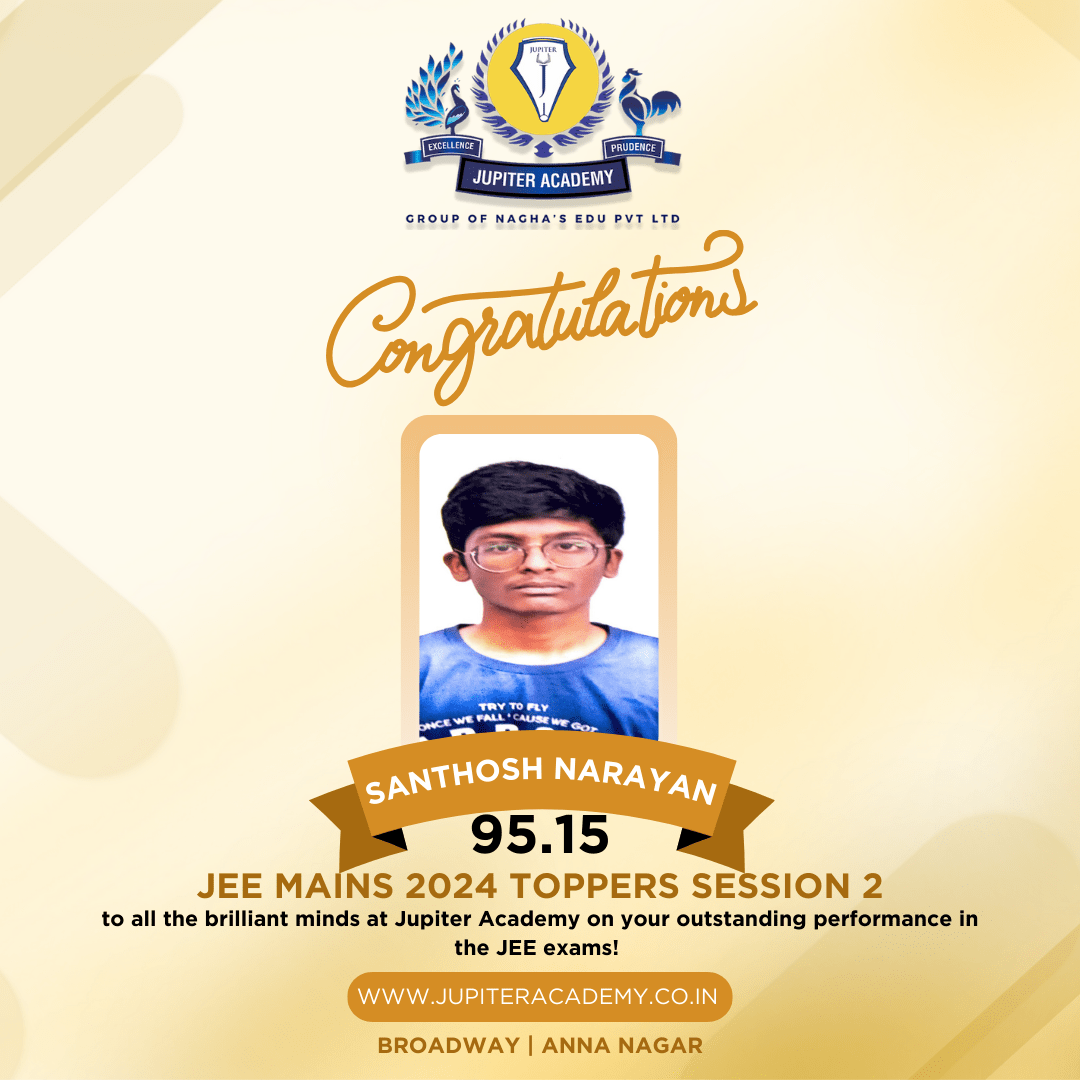
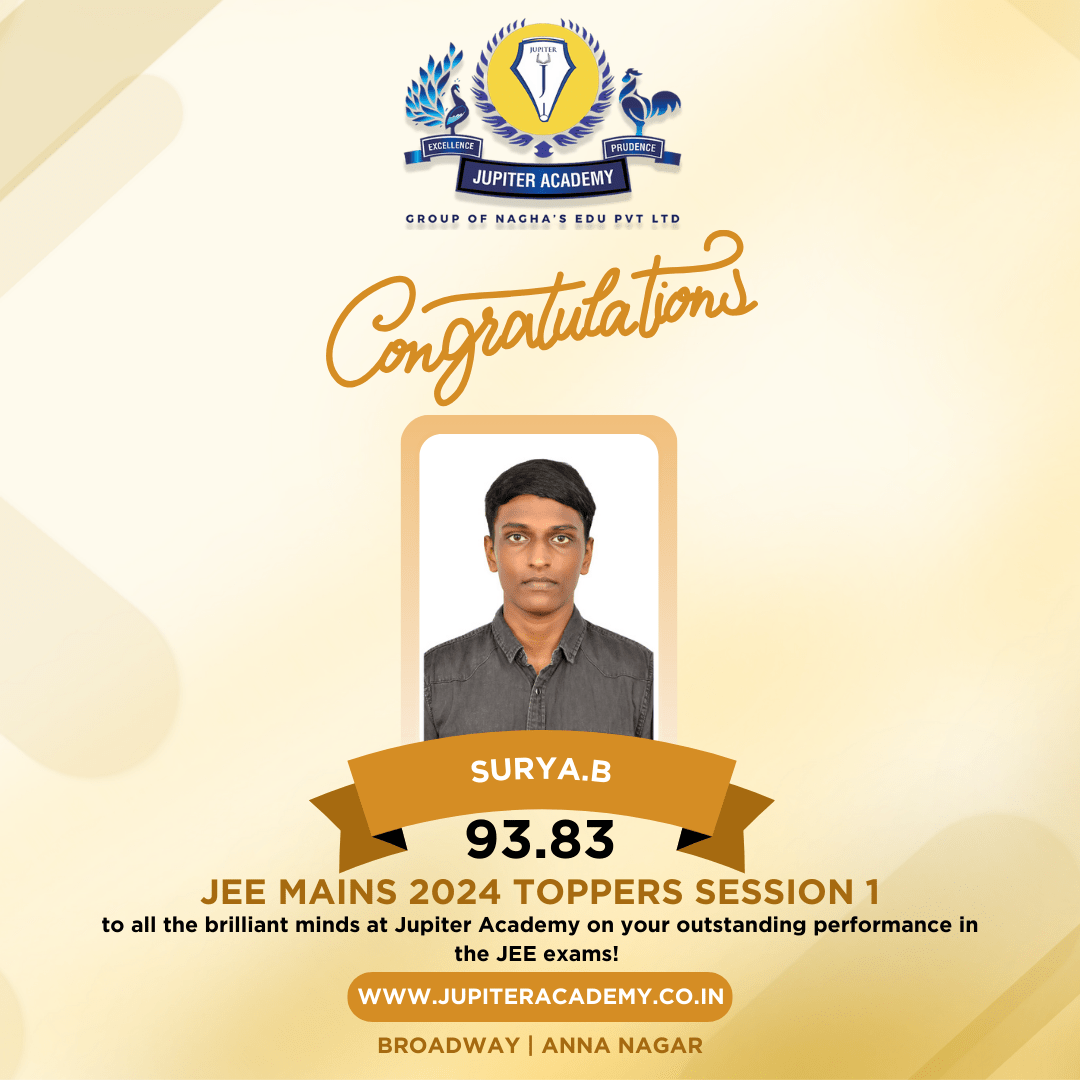
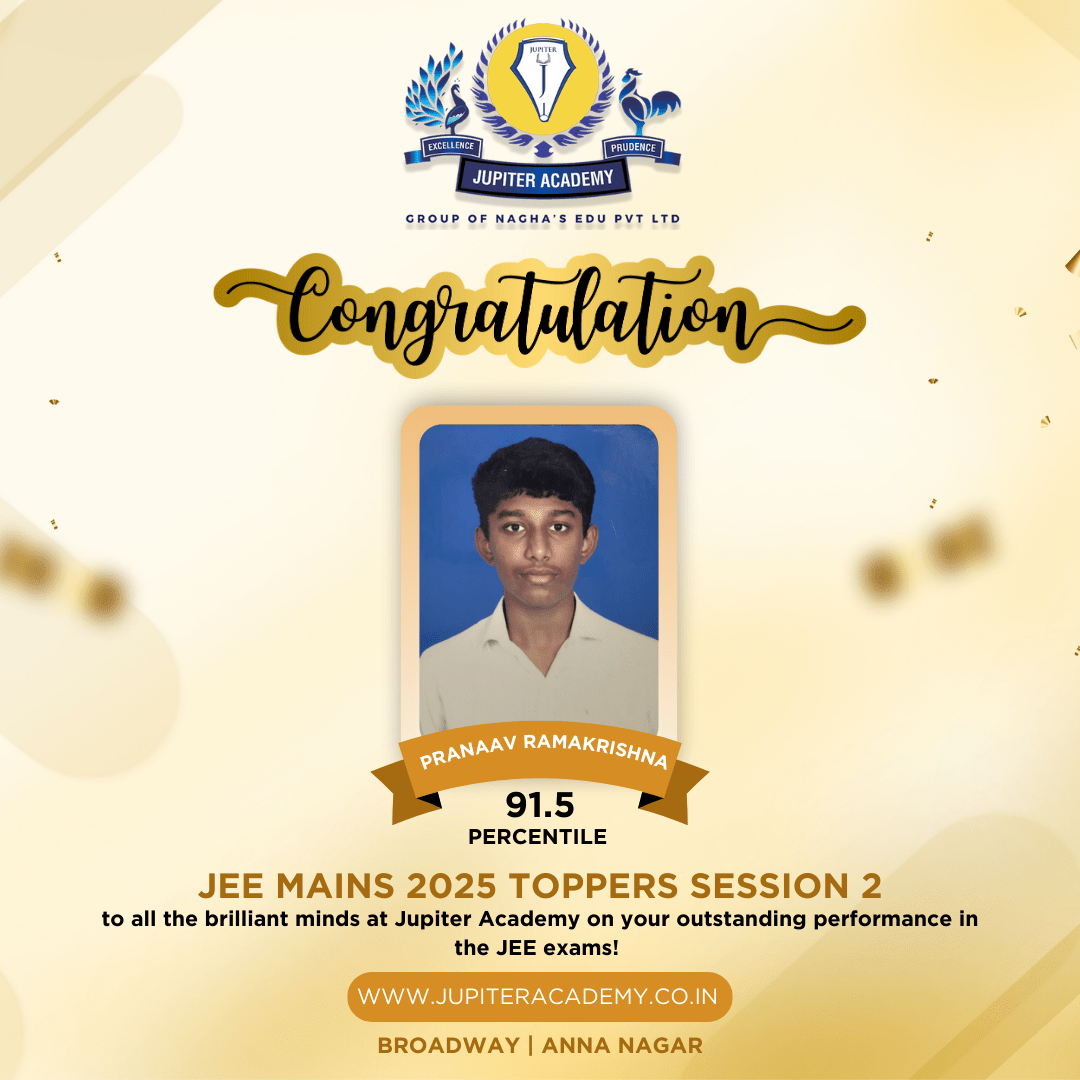
Our Results — JEE & NEET Student Achievements
Jupiter Academy students consistently crack JEE Main, JEE Advanced and NEET with top ranks, securing seats in IITs, NITs, and Government Medical Colleges.




Anna Nagar Branch
📍 2nd Avenue, AD Block, Anna Nagar, Chennai – 600040
- Prime academic location
- IIT-JEE expert faculty
- Air-conditioned classrooms
- Smart learning infrastructure
- Library & study resources
Broadway Branch
📍 Broadway, George Town, Chennai – 600108
- Central Chennai location
- Dedicated JEE Advanced faculty
- Metro & bus accessible
- Weekly mock tests centre
- Performance tracking reports
Frequently Asked Questions

Start Your IIT Journey with Jupiter Academy
Expert IIT-JEE Faculty · Small Batches · Personal Mentorship · Anna Nagar & Broadway, Chennai · Admissions Open 2026–27